How to Build an Indian Capsule Wardrobe
A practical AAINA approach to a smaller, more useful wardrobe: personal line, everyday Indian and Western outfits, local weather and a separate place for festive pieces.
An Indian capsule wardrobe is a small working collection of clothes you can combine for the life you actually lead. It need not be all neutral, exclusively Western, or limited to a prescribed number of pieces. Start with what you wear, how it feels on you, and where your week takes you.
1. Map your week before editing your wardrobe
Write down the situations you dress for: work, commuting, home, errands, dinners and gatherings. Note how often each occurs, any dress requirements, your laundry schedule and the weather you experience. A week in an air-conditioned office may call for different pieces from a week spent travelling outdoors. There is no single wardrobe for every Indian city or season.
2. Find your Personal Line in the clothes you already love
In AAINA, Personal Line means the outline fabric creates as it falls across your body. Try on three outfits you repeatedly reach for. Look at their proportions, fabric weight, shoulder fit, lengths and movement. Do you enjoy a longer uninterrupted silhouette, a defined waist, relaxed drape or compact layers? Use those observations to choose combinations you feel comfortable wearing, rather than trying to correct your body.
- Photograph favourite outfits from the front and side, with your usual shoes.
- Sit, walk and reach in each outfit; comfort matters as much as its outline.
- Record what works in plain terms, such as a straight trouser, soft shoulder or short jacket.
- Keep pieces you love even when they sit outside your usual pattern.
3. Build bridges between Indian and Western pieces
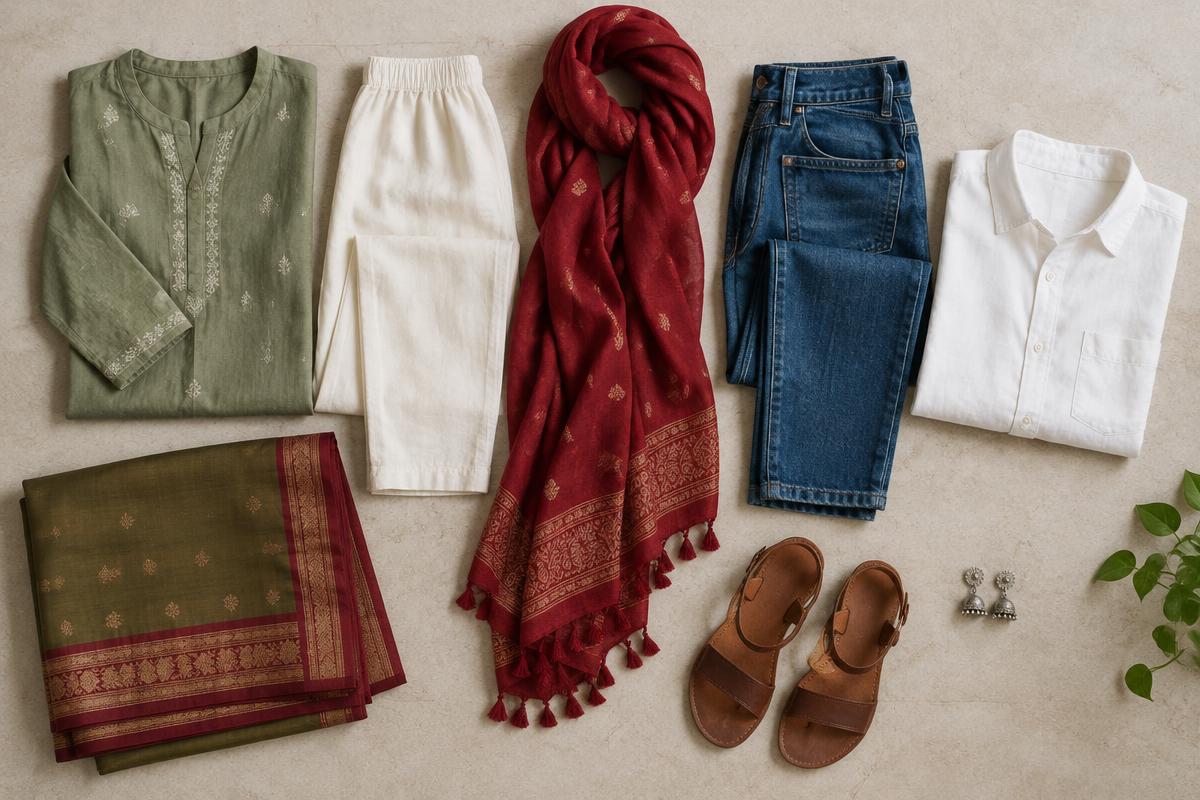
Instead of keeping two entirely separate everyday wardrobes, look for pieces that can serve more than one setting. A pair of straight trousers might work with a kurta or a shirt. A simple dupatta can change the feel of an existing kurta outfit. A jacket can add a layer when the weather and your preferences allow. Test the full outfit rather than assuming every separate will work with everything.
Begin with a combination you already wear comfortably. Try another top with the same trousers.
Choose according to your workplace, movement and personal preferences. Repeat footwear where practical.
Try a dupatta, earrings or different shoes before buying a whole new outfit.
4. Choose fabrics for your conditions, not the label alone
Assess each garment in the conditions in which you will wear it. Consider weight, weave, lining, fit, drying time and its care instructions, not simply whether the label says cotton, linen or silk. Try your commute and a full day in a piece before treating it as a reliable staple. Rotate seasonal pieces when the weather changes instead of forcing every item to work all year.
5. Keep colour and occasion wear on your own terms
Choose a few colours you genuinely enjoy combining. Your base might be indigo, ivory and green, or black with vivid accents; minimal does not have to mean beige. Lay your existing pieces together to check which combinations you like. Sarees, wedding outfits and other occasional pieces can have a separate place in the wardrobe without needing to justify everyday wear.
6. Test a working capsule before buying
- Select enough complete outfits for your next two weeks, allowing for washing and repeat wear.
- Set them apart from the rest of your wardrobe and record what you actually use.
- Put uncomfortable pieces aside for alteration, repair or reconsideration; do not rush to discard them.
- List the precise gaps you encounter, such as trousers that pair with two existing kurtas.
- Try each possible purchase with pieces you own, and check care requirements before committing.
How many pieces should an Indian capsule wardrobe contain?
Enough to cover your real activities and laundry cycle comfortably. A fixed number can be a useful experiment, but it is not a measure of success. Count complete outfits, repeat wear and practical gaps before counting garments. The goal is fewer unresolved dressing decisions, not the smallest possible closet.
Continue with AAINA
For a deeper look at Personal Line and Image Identity, explore AAINA or read Your Personal Line & the Indian Body in Articles. Return to this capsule exercise with observations from your own clothes; the framework is most useful when it helps you recognise what already feels like you.
“A useful wardrobe is not an absence of choice. It is a collection of choices you have already made well.”